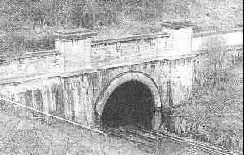


THE SEVERN RAILWAY TUNNEL
The Severn Tunnel - The Story
To the Victorians the London to South Wales was an important route, but one obstacle got in the way, the Severn Estuary. In the 1860s rail travellers on this route would have had to break their journey on reaching the Severn and take a ferry to rejoin a train on the other side. Unfortunately the Severn Estuary is known for its treacherous tides and bad weather, making an unpleasant interlude on an otherwise pleasant journey.
The Victorians produced some great engineers and they were prepared to accept the technical challenge of tunnelling under the Severn. Unaware of one hidden danger, the Great Spring!
The project began in 1873 and six years later they hit the Great Spring. Only 152 metres separated each tunnel running from the English and the Welsh shore. Within 24 hours the tunnel was flooded to river level, thankfully without any loss of life.
Huge pumps were brought in to try to pump out the water, but the spring was so big that they couldn't cope. A diver by the name of Lambert bravely entered the workings and managed, with considerable difficulty, to seal off the spring. But it wasn't until 1881 that the Great Spring was sealed off behind a giant headwall.
Since that day a massive pump has continued to pump out 50 million litres of water per day and is now sold to a local water company. The Great Spring persisted throughout the remainder of the time spent in constructing the tunnel to give problems, As did the weather, even a large tidal wave gave rise to flooding. But on the 1st December 1886 a regular passenger service was opened, cutting the journey from London to South Wales by one hour.
Work had begun two years later in 1875 on the construction of the Severn Railway Bridge which crossed the river a little upstream of Lydney and Sharpness. There was to be a lot of jealousy during the period of construction between both the tunnel and bridge companies until the bridge was finally opened in 1879.
Today the tunnel has modern diesel express trains roaring through, but the maintenance of the workings is continuous. Every Sunday the tunnel is closed to allow teams of engineers in to carry out vital work to ensure the safety of the passengers that use it.
Description:
Length:
Gradients:
Construction:
27th June 1872
18th March 1873
16th October 1879
18th December 1879
8th November 1880
4th January 1881
18th January 1881
26th September 1881
10th October 1883
17th October 188
17th October 1884
18th April 1885
5th September 1885
1st September 1886
1st December 1886
A double track, brick lined tunnel with long approach cuttings and carrying the trains under the estuary of the River Severn between Pilning and the Severn Tunnel Junction.
4 miles 574 metres
1 in 100 descent from the Bristol side.
1 in 90 rise to the Welsh side.
Begun in 1873 and completed in 1886
Act obtained to build the tunnel
Construction work began
Inundation by the Great Spring
Work taken over by Thomas Walker
Lambert, the diver, closed off the eastern heading
Great Spring sealed off
A great snowstorm
Heading joined under the Severn
The Great Spring broke in again
Flooding by an abnormal tidal wave
A through passageway completed from end to end
The last brick was keyed in
Sir Daniel Gooch travelled through the tunnel by train
A regular goods service commenced
Regular passenger train services commenced